
Elizabeth Erwin
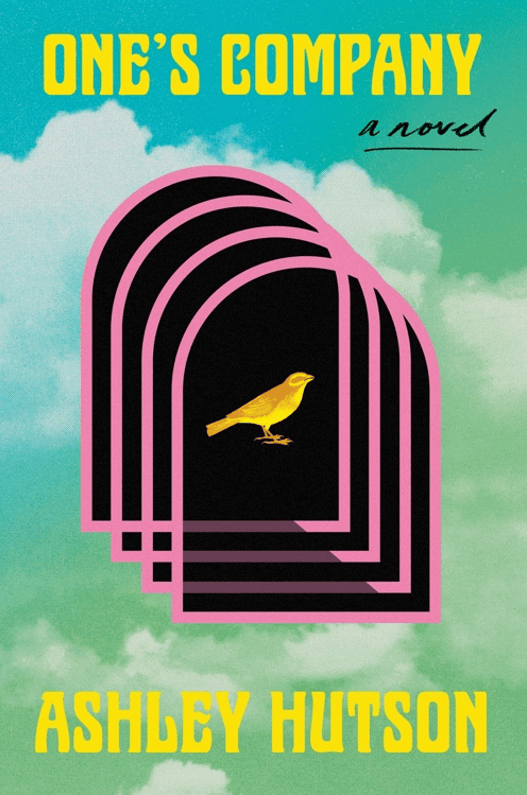 At first glance, Ashley Hutson’s One’s Company: A Novel resists the classic definition of the haunted dollhouse as it neither centers on uncanny miniatures nor is the intended plaything of a child. And yet, the replica physical environment leveraged in the novel mines similar themes of trauma negotiation and spectres of the past, albeit on a larger and more kitschy scale. Like Betty Ren Wright’s The Dollhouse Murders and Kathryn Reiss’s Time Windows, Hutson’s novel uses the haunted dollhouse metaphor to excavate how traumatic memory might be controlled and manipulated in curated, intentionally-designed spaces. But unlike traditional horror-centric dollhouse stories that end with the past being at least temporarily appeased, One’s Company insists that some ghosts are inescapable and, when combined with our national obsession for nostalgia, inevitable.
The story is a deceptively simple one. Upon winning an exorbitant amount of money in the lottery, Bonnie, a woman barely hanging on emotionally and financially, devises a plan to escape her reality by manufacturing an exact replica of the set of the sitcom, Three’s Company. There, she plans to disconnect from the world and live out her days adopting the personas of the show’s characters. As the lone survivor of a brutally violent massacre that left all but one member of her surrogate family dead, Bonnie’s unaddressed trauma is evident in both her startle response and inability to emotionally connect with anyone around her, including her best-friend, Krystal.[1] But her financial windfall means Bonnie now has the resources to transport herself from a job and living situation in which “so many tiny assaults were endured” to an environment completely under her control (Hutson 48). It is within this manufactured landscape that Bonnie’s story expands the narrative power of the haunted dollhouse.
A Dollhouse Grows Up
While the word “dollhouse” connotes a very specific image, I argue that functionally, the replica set designed in the novel operates similarly to a standard dollhouse, just on a life-size scale. Detailing the minutiae of the Three’s Company apartment complex construction process, the novel makes special note of how unobtrusive levers shift the sets of the Ropers’ apartment with Mr. Furley’s apartment to maintain effortless show continuity over the seasons. This added element suggests a type of gameplay that immediately positions Bonnie’s newly constructed environment as something more akin to a dollhouse than a space of intentional living.
Structurally, the traditional dollhouse is designed to be both familiar and easily manipulated. As such, it has historically proven to be a useful therapeutic tool in the processing of trauma (Nilsson 81-82). Though familiar household items installed throughout the house provide a sense of familiarity, it is mostly the dolls who reside within the house who offer the most obvious opportunities for imaginative gameplay, mechanics that can elucidate both conscious and unconscious thoughts. Most closely associated with children, the therapeutic benefits of doll therapy are not bound by age. While most adult-centered research explores this therapy approach within the context of Alzheimer’s and memory care (see Fraser and James, Mitchell et al.), there is also evidence that doll play can help adult patients navigate complex trauma. By “offering a sensory intervention for the projection of emotions,” doll play in adults facilitates many of the same therapeutic goals of trauma acceptance, integration and release as it does in children (Krystyniak 16). In Bonnie’s de facto dollhouse, doll play occurs as soon as Bonnie steps inside her 1970s inspired structure and cedes her true identity to slip on the skin of one of the show’s core characters. Bonnie’s inhabitation of this world is expressly described as “playing” by those around her and, when combined with the descriptions of trauma she has endured, casts her new home as a space of designed safety and predictability; a point made explicit when she references the home as an oasis in which “[t]he filth of my own life would cease to be a threat” (Hutson 69). In this respect, Bonnie’s home is therapeutic in that it enables her a chance to exist beyond the bounds of her extensive trauma independent of prying eyes and judgmental labels.
And yet, Bonnie has no desire to move past her trauma or to even address it in any meaningful way. Rather than being a space of healing, it becomes a fortress that enables her to disassociate completely. Uninterested in trauma integration, Bonnie rejects all remnants of her real existence, including her trailer with its “shrill alarm, distant yelling, [and] engines revving” and her newly purchased home with its “secret, unseen places” (48). By entering the set and closing off contact with the outside world, Bonnie effectively remains ensconced in the comforting mechanics of play, choosing the predictable loop of sitcom scripting over the jagged edges of the outside world.
And in this environment, size does matter. Though the etiology of the word “dollhouse” ties it to its miniature size, many scholars have read “the intentional representation of size discrepancy…as the desire of possessing and knowing all the visible objects in one’s own universe” (Chen 279, 283). For a child still learning their environment, miniatures in a dollhouse make sense precisely because they are so easy to tangibly explore. But for Bonnie, whose obsessive rewatching has made her already fully know the smallest intricacies of the set design (a fact made obvious in her relentless pursuit of historically accurate and identical set pieces), her knowing and financial ability to possess are already complete. Here, miniaturization would create a sense of distance that is antithetical to Bonnie’s aim. She requires size and scale to not only inhabit as accurate and proportional an environment as possible, but to eliminate the need for imagination required of smaller objects. To achieve full play immersion, she must be surrounded by things in their truest, most accurate form. Adding to this is Bonnie’s desire to blend into her surroundings, not remain removed from them. As researcher Frances Armstrong observed, “The panopticonlike structure of a dollhouse also lays the dolls themselves open to surveillance” (27). And it is exactly this type of surveillance that Bonnie is desperate to escape. Size cloaks the play and renders it less manipulation and more complete inhabitation thereby fulfilling Bonnie’s goal to fully and finally erase her past.
This shift from mechanical play intended to reveal to fully immersive play designed to escape moves the therapeutic dollhouse from a site of healing to one of controlled confinement. Unlike most haunted dollhouse narratives in which ghosts trapped in a miniature world are trying to communicate a historical trauma to an unsuspecting child, Bonnie is the mastermind of the gameplay and this distinction imbues her with a specific type of agency not typically accessible to children. She decides which character she will inhabit and for how long. But this control is not without limits. Bonnie’s play is pre-scripted courtesy of obsessive TV viewings that have equipped her with the knowledge of how the characters she seeks to inhabit will act, speak, and think, thereby significantly limiting the need for on-going, autonomous decision making. But Bonnie’s mission to effectively render herself a blank slate upon which the television show’s characters may be imprinted never considers that when it comes to haunted dollhouses, the only ghost you can’t outrun is the ghost of your own past.
An Inescapable Haunting
While the role of the haunted house has been excessively studied in Horror, the role of the haunted dollhouse less so. Creepy dollhouses involving active play are typically the purview of juvenile horror literature which, along with being itself criminally understudied, typically involve a ghost trying to communicate a historical trauma or unleash new evil. It is a haunting stemming from an event that exists outside of the person impacted, at least initially, with the dollhouse acting as a container of sorts for the original trauma. To help clarify, consider Betty Ren Wright’s The Dollhouse Murders in which a young girl, Amy, is haunted by ghosts trying to provide clues to the long ago murders of her great-grandparents by moving items within the dollhouse in a bid to point to the real killer. Though Amy certainly has generational trauma stemming from the killings, the event itself was not experienced by her directly. It is a specifically external type of haunting stemming from an original trauma that can only be replicated within the walls of the dollhouse. This differs radically from the haunting experienced by Bonnie which exists both within Bonnie and within the dollhouse she erects. That there are two types of hauntings occurring simultaneously- one internal and born of trauma and one external and born from nostalgia- shows the potential of the dollhouse to be a liminal space as opposed to a fixed structure.
Early on in One’s Company, Bonnie offers an account of the horrific things she endured the night she was attacked and her loved ones murdered. Not only do these details provide context for her anti-social and at times cruel behavior, they position the invisible spectre that haunts Bonnie as an invisible force of memory that lives in her body. Research increasingly suggests that memories stemming from trauma function as “an alternative cognitive entity” (Harpaz-Rotem and Krystal) that “bypass[es] consciousness perception and the consciousness, and fall directly into the psyche” (Hartman 537). As Deborah Bradley observes, “trauma may reside in implicit memory in the way that its very unassimilated nature…returns to haunt the survivor later on” (6). For Bonnie, the spectre of endured violence is always present, even when she’s unaware of its proximity. She is haunted by her own memories; memories that have an agency of their own as they frequently intrude into Bonnie’s psyche despite her best efforts to keep them at bay.

Figure 1 The Three’s Company set along with its original characters.
Plagued by flashbacks and enduring the loss of bodily control in the wake of experiencing a trigger, Bonnie’s Post Traumatic Stress Disorder (PTSD) responses are obvious but remain unaddressed by her and those around her. While Krystal knows that Bonnie needs help, she is too mired in her own grief, at least initially, to be of much assistance. Krystal’s one overt act of support is bringing Bonnie to her home after the attack and setting her up on the couch before retreating to her bedroom to attend to her own grief. Uncoincidentally, it is in the aftermath of being “abandoned” on the couch that Bonnie discovers the halcyon draw of Three’s Company, her description of which leaves no question as to the nostalgic genesis of its appeal:
Then, suddenly, a glow emanated from the screen. It was golden, like God. The warm air of the 1970s wafted over me, and I fell into a paralytic hypnosis. A show played on the screen but another thing was happening on a separate level, inside a secret flap of consciousness, and there was something autumnal about the feeling it generated, deep and nostalgic, regressing my heart to a past date that might have been real and might have been a mishmash of fiction or advertisements or childhood happiness…My reality cracked open, and the television spooned another one on top (Hutson 35)
It is impossible to separate out Bonnie’s sense of refuge here with the mechanics of nostalgia at play. Originally coined by Johannes Hofer to describe a medical malady of “homesickness,” the nostalgia of Hutson’s universe functions specifically as a haunting “for a future that never came to be” and casts Three’s Company as something of an uncanny simulacrum (Summers). Dismissed by critics as “jiggle” television, the ABC series was never designed to be taken seriously, with plots frequently recycled and reliant upon unrealistic hijinks. But frequent reruns embedded the show within the national (and cultural) memory to such a degree that its familiarity alone elicits comfort even while we recognize its artifice (Gatchman). Often, a haunted dollhouse will resemble the house lived in by a child or is bestowed by a relative implying a shared history. Here, popular culture becomes that shared history. When Bonnie enters her dollhouse for the first time, she is immediately overwhelmed by its familiarity and the comfort it evokes: “The gray lamp to the left of the door, the Whymper pheasant prints and Wysocki folk art on the wall off to the right, the small Duncan Phyfe tables, the glassfront bookcase cabinet…It was here, and it was real” (101). But it is that same familiarity that traps her in the past, a fact disguised initially by the dollhouse’s 1970s curated perfection and its suggestion of a time we have culturally come to view as “simpler.”
Reflecting Mark Fisher’s framing of a haunting as “a failed mourning” and a “spectre [that] will not allow us to settle,” nostalgia itself becomes the container in which Bonnie first invests her trauma (22). Her obsessive love for the show stems from its rerun predictability and how the show depicts its relationships. The draw is a captured moment in time where “[e]veryone always knew their part, their value” and where acceptance is freely given (Hutson 68). But this acceptance can only exist in the nostalgic past where it remains unthreatened by human foibles or outside influences. When emotional comfort gives way to a desire to make that past tangible, Bonnie’s connection to the show moves from periodic escapism to trapped obsession.
It begins when Bonnie starts to hoard multiple sets of the same season of DVDs for fear one set will break and she won’t have on-demand access to the show. She keeps these “treasures” locked in a closet so that they are only accessible to her and the combination of private obsession and tangible artifact create an environment rich for happier (albeit fictitious) nostalgia to map over the memories she’s desperate to erase. Winning the lottery enables her to escalate this obsession to the physical landscape of her dollhouse. The addition of this physical landscape designed and decorated to evoke a distant past does nothing to permanently alter that which haunts Bonnie. If anything, it adds an additional layer of haunting that, in the end, proves inescapable.
The novel’s ending is an ambiguous one. Ostensibly, the spectres that haunt Bonnie converge when Bonnie’s physical Three’s Company dollhouse burns to the ground and she is institutionalized by a concerned Krystal. There is also an alternate way to read the ending that positions the events in the novel as traumatic hallucinations. Was Rita real? If so, did Bonnie kill her? Did Bonnie kill Krystal? Was Bonnie in treatment the entire time? The written ending is the one I have explored but it needs to be noted that Bonnie is an unreliable narrator. The contrast between the two’s trajectories is stark. When Bonnie refused to buy Krystal’s family home, she prevented the ghosts of Krystal’s lost family from becoming a permanent albatross that keeps her mired in her grief. Forced to move away from her family home, Krystal is able to process her grief and learn how to focus on the future, which results in positives such as a new job and romantic relationship. But for Bonnie, there is no similar optimistic ending. Though banned by the therapy facility from watching Three’s Company, a misguided friend smuggles in a hard drive of episodes and we are left with the sense that history is about to repeat itself. As she presses the hidden earphones to her ears and reenters apartment #201, it becomes clear that Bonnie’s haunting is permanent and that she is now trapped in a dollhouse without physical walls and no doors from which to escape.
Notes
[1] Bonnie’s surrogate family is also Krystal’s biological family.
Works Cited
Bradley, Deborah. “We Are All Haunted: Cultural Understanding and the Paradox of Trauma.” Philosophy of Music Education Review, vol. 28, no. 1, 2020, pp. 4-23. JSTOR, https://doi.org/10.2979/philmusieducrevi.28.1.02. Accessed 8 May 2026.
Chen, Nancy Wei-Ning. “Playing with Size and Reality: The Fascination of a Dolls’ House World.” Children’s Literature in Education, vol. 46, no. 3, 2015, pp. 278-295.
Fisher, Mark. Ghosts of My Life: Writings on Depression, Hauntology and Lost Futures. Zero Books, 2014.
Fraser, Faye, and Ian James. “Why Does Doll Therapy Improve the Well-being of Some Older Adults with Dementia.” PSIGE Newsletter, vol. 105, 2008, pp. 55-63.
Gachman, Dina. “Comfort Viewing: 3 Reasons I Love ‘Three’s Company’.” New York Times (Online), New York Times Company, 11 Sept. 2020.
Harpaz-Rotem, Ilan, and John H. Krystal. “PTSD Trauma Memories Are Not Represented in the Brain Like Other Memories, Study Suggests.” Brain and Behavior Research Foundation, 29 Feb. 2024.
Hartman, Geoffrey H. “On Traumatic Knowledge and Literary Studies.” New Literary History, vol. 26, no. 3, 1995, pp. 537-563.
Hutson, Ashley. One’s Company: A Novel. W. W. Norton & Company, 2022.
Krystyniak, Jennifer. “The Use of Dolls and Figures in Therapy: A Literature Review.” Digital Commons@Lesley, Lesley University, May 2020.
Mitchell, Gary, Brendan McCormack, and Tanya McCance. “Therapeutic Use of Dolls for People Living with Dementia: A Critical Review of the Literature.” Dementia, vol. 15, no. 5, 2016, pp. 976-1001.
Nilsson, May. “The Dolls’ House: Dream or Reality? A Borderline Girl’s Psychotherapy.” Journal of Child Psychotherapy, vol. 26, no. 1, Apr. 2000, pp. 79–96.
Prichard, Natalie. “Stuck in the Dollhouse: A Brain-Based Perspective of Post-Traumatic Play.”
Challenges in the Theory and Practice of Play Therapy, edited by David Le Vay and Elise Cuschieri, Routledge, 2016, pp. 71-85.
Summers, Cameron. “Future Less Vivid.” Broken Hands, 15 Sept. 2021.
“Three’s Company.” Created by Don Nicholl, Michael Ross, and Bernard West, performances by John Ritter, Joyce DeWitt, and Suzanne Somers, ABC, 1977–1984.
Wright, Betty Ren. The Dollhouse Murders. Holiday House, 1983.


